Quickstart
In a few minutes: declare errors, register the handler, use them in a route and get a typed OpenAPI.
1. Declare codes and error classes
An error code is any member of your StrEnum (or a bare Literal["CODE"]). A class only needs to declare http_status; the metaclass derives the rest.
from enum import StrEnum
from http import HTTPStatus
from typing import Literal

from fastapi_typed_errors import BaseError


class ErrorCode(StrEnum):
    NOT_FOUND = "NOT_FOUND"
    FORBIDDEN = "FORBIDDEN"


class NotFoundError(BaseError[Literal[ErrorCode.NOT_FOUND]]):
    http_status = HTTPStatus.NOT_FOUND
    description = "Requested entity does not exist"  # (1)!


class ForbiddenError(BaseError[Literal[ErrorCode.FORBIDDEN]]):
    http_status = HTTPStatus.FORBIDDEN
descriptionis optional; it is used as the defaultdetailand as the status description in OpenAPI.
2. Register the handler
Explicitly, the FastAPI way — just like app.add_middleware(...). The package does nothing behind your back.
from fastapi import FastAPI
from fastapi_typed_errors import BaseError, handle_base_error

app = FastAPI()
app.add_exception_handler(BaseError, handle_base_error)
Why BaseError rather than each class
Starlette resolves handlers by walking the exception's __mro__, so one handler on BaseError covers every subclass while leaving plain HTTPException alone.
3. Wrap the router and declare errors in the annotation
with_errors returns the same router and teaches it to understand the Raises marker in the return annotation.
from typing import Annotated

from fastapi import APIRouter
from pydantic import BaseModel

from fastapi_typed_errors import Raises, with_errors


class Item(BaseModel):
    item_id: int


router = with_errors(APIRouter())


@router.get("/items/{item_id}")
def get_item(item_id: int) -> Annotated[Item, Raises[NotFoundError, ForbiddenError]]:
    if item_id == 0:
        raise NotFoundError(f"No item {item_id}")
    return Item(item_id=item_id)


app.include_router(router)
4. The result
The error response body always has the shape {code, detail}:
And in OpenAPI the route gets one entry per status — with an exact Literal code and a body model. Here is how it renders in Swagger UI:
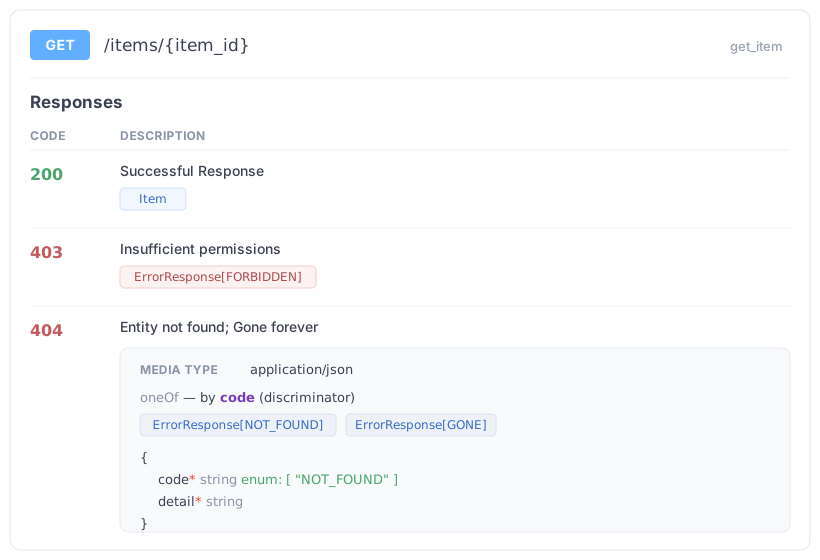
Under the hood it is exactly the OpenAPI that Swagger renders:
{
  "404": {
    "description": "Requested entity does not exist",
    "content": {
      "application/json": {
        "schema": { "$ref": "#/components/schemas/ErrorResponse_Literal_NOT_FOUND__" }
      }
    }
  },
  "403": {
    "description": "Forbidden",
    "content": {
      "application/json": {
        "schema": { "$ref": "#/components/schemas/ErrorResponse_Literal_FORBIDDEN__" }
      }
    }
  }
}
The key part — code is typed as const: "NOT_FOUND": the client sees the exact value, not "just a string". Several errors on one status automatically become a discriminated oneOf union on code (like the 404 in the illustration above) — Swagger UI shows a variant picker by code value.
Check it yourself